

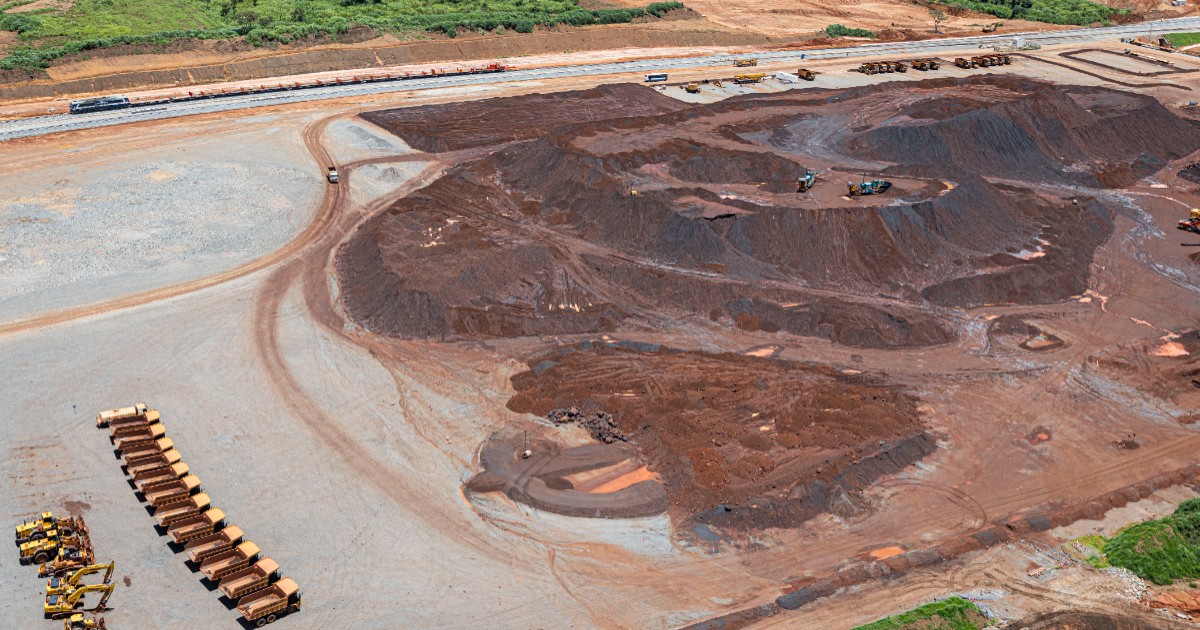
The $23 billion project, which integrates mining with a 600-kilometre railway to the deep-water port of Morebaya, has already shipped its first cargo to China, marking the start of its influence on global supply chains.
The launch on 11 November was attended by Guinea’s leader, General Mamady Doumbouya, Chinese Vice-Premier Liu Guozhong, and Rwandan President Paul Kagame. Doumbouya declared a public holiday, underlining the mine’s strategic and domestic significance.
ADVERTISEMENT
China remains the largest importer, accounting for roughly three-quarters of global shipments, driven by urbanisation, construction, and the industrial machinery sector. In 2024, Chinese imports reached a record 1.24 billion tonnes, up 4.9% year-on-year.
First explored in the 1950s, the Simandou deposit faced decades of delays due to political instability, corruption, and legal disputes.
Today, two mining blocks are being developed by the Singapore-Chinese Winning Consortium Simandou, with the remaining two managed by Simfer, a joint venture between Rio Tinto, Chalco Iron Ore Holdings, and the Guinean government.
China Baowu Steel Group holds stakes across both ventures, reinforcing its integration with China’s industrial strategy.
Simandou’s Premium Ore Fuels China’s Green Steel Push
ADVERTISEMENT
At full capacity, Simandou is expected to produce 120 million tonnes of high-grade ore annually, representing nearly 10% of China’s 2024 imports and positioning the project as the world’s fifth-largest producer.
Hu Wangming, chair of Baowu, described the launch as “a significant milestone in the global mining industry”, highlighting the deposit’s premium quality crucial for low-carbon steel production.
Simandou’s high-grade “green ore” will support China’s decarbonisation goals by reducing energy requirements in steelmaking.
Bilateral trade with China has surged, reaching $9.05 billion in 2023, up 34% from the previous year. Liu Guozhong called the project the culmination of “nearly 70 years of friendship and cooperation”.
ADVERTISEMENT
Global and Geopolitical Implications
The mine also has global market implications. Analysts suggest that the entry of Simandou’s premium ore could depress prices, pressuring higher-cost producers in Australia and Brazil.
However, challenges remain. Maintaining the mine’s extensive infrastructure, managing political volatility, and navigating reliance on a single buyer, China, will be critical to long-term success.
Recent incidents, such as Guinean authorities turning back 18 Chinese-built locomotives due to local sourcing requirements, illustrate the complexities of governance and regional compliance.
ADVERTISEMENT
Geopolitically, Simandou places Guinea at the centre of Africa-China trade and scrutiny from rival powers. As the US promotes “friend-shoring” to reduce reliance on Chinese-linked supply chains, the project highlights the intersection of industrial policy, resource security, and global competition.
Simandou’s operational debut signals a new era for Africa’s resource sector, potentially transforming Guinea into a hub for green steel and positioning the continent as a critical player in global industrial supply chains.
How Guinea and its partners manage governance, infrastructure, and market dynamics will determine whether the mine becomes a catalyst for shared growth or a flashpoint in global competition.