



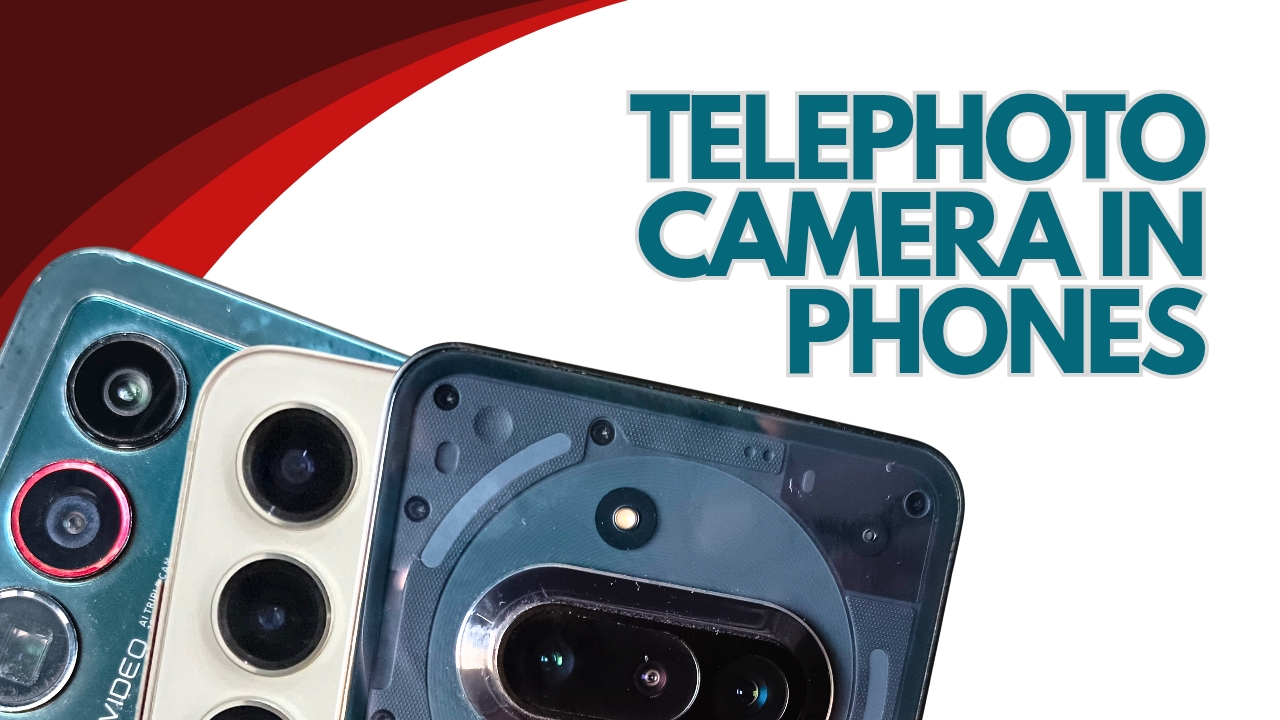

In summary, a telephoto lens in a mobile device is an advanced piece of camera technology for capturing high-quality, zoomed-in shots with professional perspective and detail.
It is a dedicated secondary or tertiary camera that allows you to zoom in on distant subjects without losing image quality, offering a feature known as optical zoom.
How Optical Zoom Works
Unlike digital zoom, which simply crops and enlarges the pixels from the main camera (making the image blurry or “grainy”), a telephoto lens uses its own set of glass elements (its own separate optics) to physically magnify the image before it hits the sensor. Because it uses its own glass, it captures real, clean image detail, resulting in a high-quality zoomed-in photo.
Zoom Factor
Telephoto lenses on phones are usually rated by their optical zoom factor relative to the main camera, such as 2x, 3x, or 5x optical zoom. For example, a 3x telephoto lens has a focal length that is three times longer than the main lens.
Table of Contents
Benefits of Telephoto Lens in a Smartphone
Optical Zoom. This is the main advantage and function of a telephoto lens. It brings distant objects closer without a loss of quality.
Background Compression: A long focal length creates a visual effect called compression, where the distance between the subject in the foreground and the background elements (like a mountain or building) appears much shorter. This makes the background feel closer and more impactful, which is great for travel and landscape photography.
Better Portraits: The telephoto lens usually offers a more natural perspective that is flattering for faces, similar to dedicated portrait lenses on professional cameras. It avoids the subtle distortion (a slight widening/bulging effect) you can get when using the phone’s main wide-angle lens for a close-up portrait. It also naturally creates a shallower depth of field (background blur, or bokeh) to isolate the subject.
Isolation and Cropping: It allows you to look past clutter and isolate a single, specific detail in a busy scene—a flower, a street sign, or a specific face in a crowd—to create a focused, intentional composition.
Types of Telephoto Lens in Mobile Phones
There are two types of telephoto lens in mobile phones. This is primarily because of space constraints. To fit a long focal length into a thin phone body, manufacturers use clever engineering as seen in the distinction between the two types of telephoto lens.
1. Standard Telephoto Lens
The regular or standard telephoto lens has a camera module that is only slightly thicker than the main camera but still provides a moderate zoom, albeit limited, e.g., 2x or 3x.
2. Periscope Telephoto Lens
To achieve greater optical zoom (5x, 10x, etc), designers had to come up with a way to fit in more lenses into the small body of a mobile phone.
And so they came up with the idea of using a prism or mirror to bend the light 90 degrees, allowing the optical elements to be placed sideways inside the phone’s body instead of sticking straight out like it obtains in dedicated cameras. This allows for a much longer focal length without making the phone excessively thick.
A periscope telephoto lens is a more advanced telephoto lens for achieving greater zoom.
You can watch the video explaining telephoto lens in mobile devices on YouTube. There are other types of lenses and cameras in mobile devices, and you can explore them in our detailed article titled, Types of Smartphone Camera Lenses: Wide, Ultrawide, Depth, Bokeh, Macro, Zoom, Telephoto, Periscope, Explained in Easy Terms.