



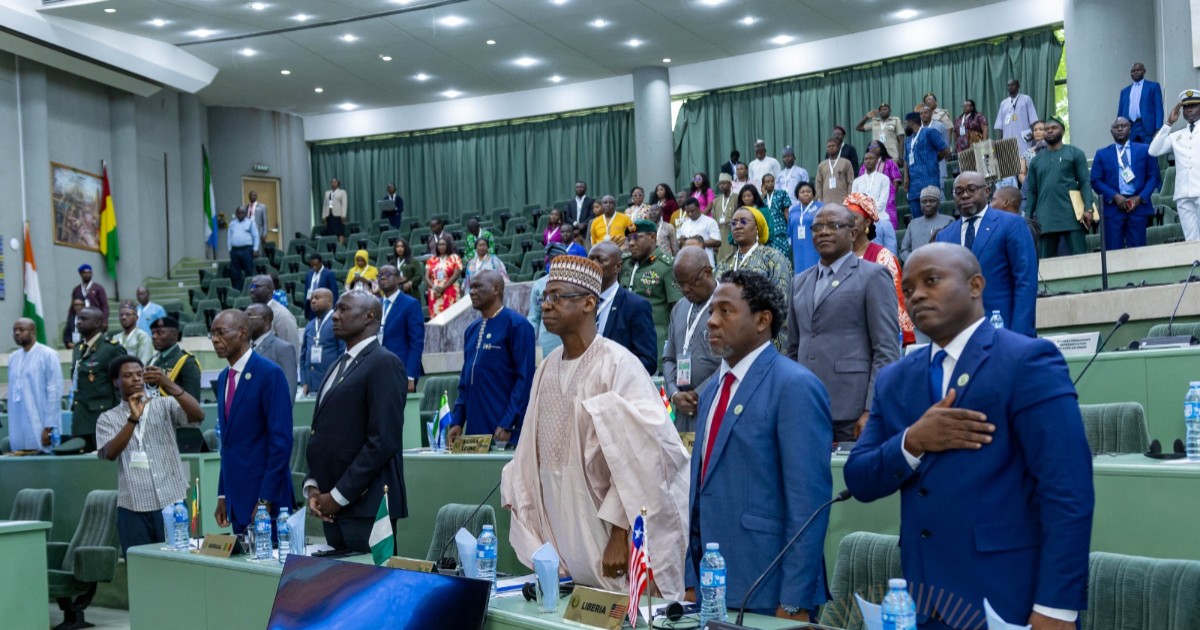
During Wednesday’s World Human Rights Day commemoration, the ECOWAS Court’s Deputy Chief Registrar, Gaye Sowe, highlighted enforcement data showing a persistent pattern of non-compliance among several member states, with Nigeria, Togo, and Senegal carrying the largest backlogs.
According to Sowe, Nigeria has about 50 unenforced judgments out of 125 total cases, underscoring the magnitude of non-compliance in some countries.
Caseload and Enforcement Overview
ADVERTISEMENT
Sowe also provided a broader overview of the court’s caseload, highlighting both pending and enforceable judgments. “As of today, the total number of cases filed before the ECOWAS Court of Justice stands at 775. Excluding the AES countries, the total drops to 702. The total number of judgments delivered involving AES countries is 492, while without the AES, it is 419. The court currently has 136 pending cases. Out of the 419 judgments involving AES countries, 192 are enforceable. By enforceable, we mean cases in which member states or defendants are required to take specific measures,” he said.
While highlighting this enforcement gap, the court official stressed that fully implemented rulings often set critical legal precedents and reinforce the authority of the regional bloc.
He also noted that most member states had established competent national authorities to enforce judgments. “Out of the 12 member states, 10 have done so. We only have Benin and Cabo Verde that haven’t done so yet,” he said.
A breakdown of enforcement by country is shown in the table below:
ADVERTISEMENT
Human Rights Rulings Undermined by Non-Compliance
President of the ECOWAS Community Court of Justice, Ricardo Gonçalves, emphasised that the court has delivered progressive judgments advancing rights such as freedom of expression, assembly, education, and a healthy environment. “The court is concerned that ECOWAS member states are yet to implement most of its judgments. Without effective and total implementation of the court’s judgments, the promise of human rights protection offered by the 2005 Supplementary Protocol becomes a mirage,” he said.
Gonçalves noted that these rulings hold states accountable for violations of civil, political, economic, social, and cultural rights. By progressively interpreting international human rights norms, the court has helped align member states’ laws and policies with their international obligations.
Political Instability Compounds Enforcement Challenges
ADVERTISEMENT
Touray warned that the region now faces “an average high-risk rating across member states” due to military interventions, fragile transitions, shrinking political inclusivity, and rising threats from terrorist and criminal networks.
“Events of the last few weeks have shown the imperative of serious introspection on the future of our democracy and the urgent need to invest in the security of our community,” he said, citing recent crises in Guinea-Bissau, Benin, and Guinea.
He added that elections have become major triggers of unrest, compounded by external geopolitical pressures.
Touray also highlighted a worsening humanitarian crisis, with 7.6 million people forcibly displaced across West Africa, including over 6.5 million internally displaced, concentrated in Nigeria, Burkina Faso, Niger, and Mali.
Call for Stronger Enforcement and Human Rights Protections
ADVERTISEMENT
Gonçalves and the registrar urged member states to enforce judgments more rigorously, cooperate with national and regional human rights bodies, and ensure citizens have unimpeded access to justice.