


By the time Mubashir was allowed to prove who he was, it no longer mattered.
In mid-December, the 20-year-old Minneapolis resident was walking through the city’s Cedar-Riverside neighborhood when federal immigration officers stopped him. He offered to show identification. They refused, according to reporting by Sahan Journal. Instead, a now-viral video of the incident shows agents putting Mubashir, who has said he only wants to give out his first name, in a chokehold, forcing him to the ground, and handcuffing him in front of bystanders.
For roughly 20 minutes, Mubashir says, he repeatedly asked to show his I.D., which officers declined. Instead, they took him to a federal building that houses immigration court and Immigration and Customs Enforcement offices, fingerprinted him, and ran his biometrics through federal systems. When officers finally allowed him to present his identification, it confirmed what he had said all along: He is an American citizen.
What happened on a snowy sidewalk in Minneapolis offers a glimpse of where the road is heading for immigration enforcement in the United States. Under Donald Trump, theDepartment of Homeland Security (DHS) is attempting to rewrite the rules on how the government collects and uses DNA, claiming legal authority to treat the entire human body — its structures, its sounds, even its molecular code — as government data.
In early November, U.S. Citizenship and Immigration Services (USCIS) — a component of DHS — proposed a sweeping redefinition of the “biometrics” it can collect from anyone tied to an immigration process.
The change would radically widen what the government considers fair game: voice prints, iris scans, so-called “behavioral characteristics,” and DNA itself. Under the proposal, the entire body becomes data — the raw material for a permanent, “person-centric” dossier that can follow people for years, trigger recurring vetting, and be shared across law enforcement, intelligence agencies, and even foreign governments.
An even more recent proposal extends this approach to short-term visitors as well, expanding biometric collection for tourists entering and leaving the United States through revisions to the federal arrival-and-departure record.
Increasingly, identity doesn’t live on paper; it is something the government extracts from your body. This didn’t come out of nowhere. On his first day back in office, Trump signed an executive order containing a blunt directive: DHS should start collecting DNA from everyone it detains, breathing new life into an existing law allowing federal agents to take genetic samples from anyone in immigration custody.
“Our data is the most important currency that we have in our world at this point in time,” says Texas civil rights attorney Rochelle Garza. “How we treat immigrants is always the canary in the coal mine for how we feel about civil rights in this country.”
Garza knows this terrain better than most. As president of the Texas Civil Rights Project, and chair of the United States Commission on Civil Rights whom, according to Politico, Trump has tried to oust in recent months, Garza has spent years watching the border serve as a laboratory for civil-rights erosion.
What she sees working in the Texas borderlands is a warning shot for the rest of the country.
“The entire country has realized that the border has come to them, to their doorstep,” she says. “The border has always been the testing ground for taking away civil rights, and it’s now being exported to the rest of the country.”
What Is Actually Being Proposed?
What DHS is now proposing reads like a blueprint for how far a government can reach into the human body.
Tucked into dense language, the agency seeks to redefine “biometrics” so broadly that almost nothing about a person is off-limits. While DHS already has authority to collect DNA in limited enforcement contexts, the proposal folds it into an expansive definition that also includes iris scans, retina maps, palm patterns, facial structure, voice texture, and behavioral characteristics. In DHS’s own words, any “measurable biological (anatomical, physiological, or molecular structure) or behavioral characteristic of an individual” becomes fair game. The proposal wraps all of this in what DHS calls a “biometrically-based, person-centric records model,” a permanent dossier that shadows a person for years, and wouldn’t close until, they claim, citizenship is obtained.
DHS also lays out a regime of “enhanced and continuous vetting,” meaning the government intends to keep re-screening people throughout “the entire immigration lifecycle” to ensure they “continue to present no risks to national security or public safety.”
Under the proposal, anyone who files or is associated with an immigration request — including petitioners, sponsors, household members, and in some cases U.S. citizens — may be required to appear at a DHS-designated location to submit biometrics.
This opens the door for immigration bureaucracy to sweep millions of ordinary people into a biometric capture system once aimed only at migrants in custody.
DHS says these “person-centric” records would close once someone obtains U.S. citizenship. But “closed” does not mean erased. The proposal creates no automatic right to delete biometrics collected along the way, and many of the people swept into the system are captured because of someone else’s case, not their own. By the time a file is theoretically closed, biometrics may already have been retained under existing schedules, shared across agencies, and used for years of screening and re-vetting.
DHS once had strict age limits on whose biometrics it could collect. The new rule wipes those out entirely. In the name of “identity management throughout the immigration lifecycle,” the department is seeking authority to take biometrics from anyone, of any age, in any immigration-related setting — in effect, asking to eliminate the last remaining guardrails on who can be biometrically scanned.
The proposal even reaches into the Violence Against Women Act, which provides a humanitarian path for survivors of domestic abuse to seek legal status without relying on their abusers. Because VAWA protections are processed through Citizenship and Immigration Services, they fall under the same benefit request umbrella DHS is now trying to rewire. Under today’s rules, VAWA self-petitioners can demonstrate “good moral character” by submitting police clearance letters or a sworn affidavit. DHS now wants to replace that with mandatory biometric collection for every applicant.
The agency estimates this expansion will capture an additional one million biometric submissions per year or more. That surge would push the federal biometric pipeline to well over three million people annually, according to the proposal.
The proposal is open for public comment through Jan. 2, 2026. After that, DHS can finalize the rule through the administrative process, without a vote in Congress. Unless blocked by a court challenge or new legislation, the policy could be implemented soon after — locking in one of the largest biometric expansions in U.S. history.
DHS did not respond to requests for comment for this story.
How Things Work Now
Under current law, DHS already has extraordinary latitude to collect DNA from non-citizens detained under federal authority, a category broad enough to include many asylum seekers and visa holders with no criminal history at all.
The process looks like this:
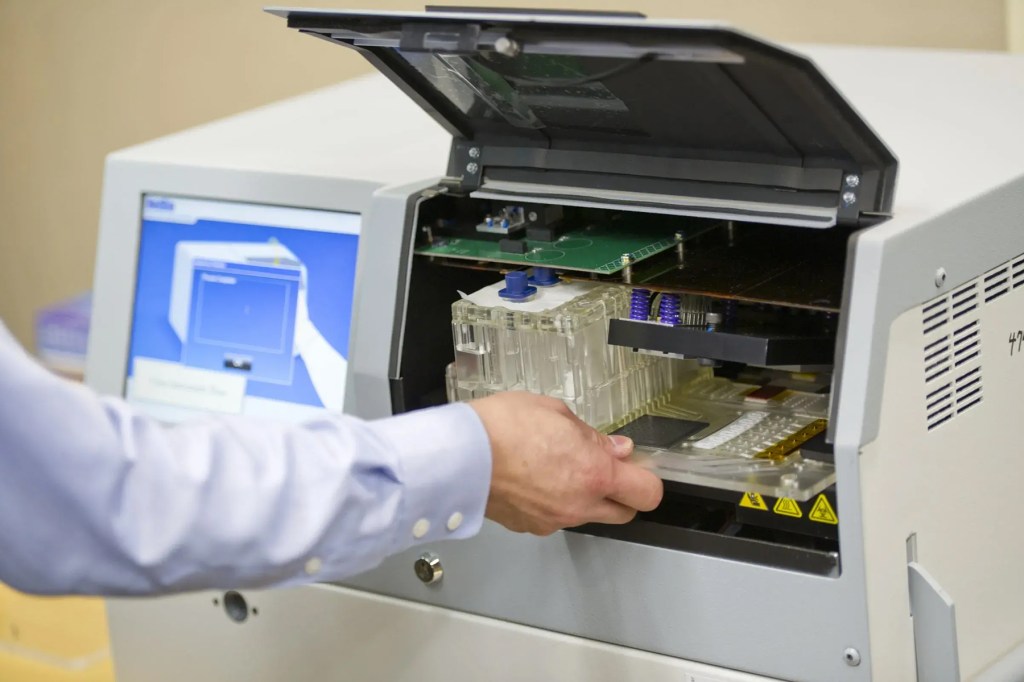
In the field, Border Patrol or ICE officers take a cheek swab during booking or intake, then send the sample to an FBI-contracted lab for analysis. DHS has also deployed Rapid DNA machines in certain facilities, allowing agents to run an on-site analysis in roughly 90 minutes. The agency says the swabs help confirm or disprove parent-child relationships and combat trafficking.
The genetic material is uploaded into the national criminal DNA database known as CODIS (Combined DNA Index System), where it is retained indefinitely.
“CODIS is a very closed system. It’s a secure database. The FBI keeps it really locked down so that it cannot be compromised,” says Sara Huston, a principal investigator of the Genetics and Justice Laboratory at Northwestern University’s Feinberg School of Medicine, which studies how genetic technologies intersect with the criminal legal system. Huston, who used CODIS while working in a forensic crime lab in the early 2000s, says only a small, tightly controlled set of labs and agencies can interface with it.
This database holds far less genetic information than people imagine, with just enough to confirm identity or close biological relationships and nothing more. It stores no names, almost no biographical data. The link between a DNA profile and a person’s identity stays with the local lab that uploaded it. By design, says Huston, “you cannot cross-reference CODIS outside of CODIS.” Even inside the system, its usefulness stops at basic identification. It cannot reveal health risks, traits, ethnicity, or anything resembling a full DNA profile.
The database only contains DNA collected and processed inside a DOJ–controlled chain of custody.

For years, DHS operated under a DOJ exemption that prevented it from collecting DNA at all. The first Trump administration eliminated that exemption, building the chain-of-custody workaround needed for Border Patrol officers to feed samples into CODIS.
“They had to figure out a way to permit Border Patrol to be part of the chain of custody, since CODIS requires it to be a law-enforcement agent to take the sample,” Huston explains. “They figured that out back in the first Trump administration so that the hold could be removed.”
But CODIS was never built for this.
As Huston explains, the system was designed to store DNA from people convicted of crimes so investigators could match those profiles against evidence in unsolved cases. That original logic, she argues, has now been flipped on its head.
“We’re searching not for their crime of border crossing, but potentially that they will be involved in some sort of violent crime in the future,” Huston says, “and I don’t understand why border crossing means that they should have a higher degree of surveillance. It undermines the whole system. It was originally set up to solve historic crimes, not to surveil for future crimes.”
But if this second Trump administration has their way, the immigration system could soon become a massive genetic surveillance apparatus extending even further beyond the intent of its framework.
It may come as a surprise, but this moment is 20 years in the making.
A 20-Year-Old Trojan Horse
Despite the tenacity of the Trump administration’s pursuit of immigration reform, what is happening now is the culmination of decades of bipartisan groundwork that steadily expanded the federal government’s power to collect and store DNA.
Twenty years ago under President George W. Bush, the DNA Fingerprint Act of 2005, introduced by then-Senator Jon Kyl (R-Ariz.), blew open the gates of a legal pathway for the federal government to start DNA collection as a front-end identification tool. It expanded upon a Clinton-era bill from 1994 that had allowed the establishment of CODIS, mainly framed as a crime solving tool for forensic casework.
“We couldn’t find evidence in the record of any real debate over the expansion of DNA collection from criminal policing into the immigration space, but it did happen in 2005,” says Stephanie Glaberson, director of research and advocacy for the Center on Privacy and Technology at Georgetown Law.
In 2005, the act was smuggled in through bureaucratic sleight of hand, buried deep inside a dense reauthorization of the Violence Against Women Act — a politically untouchable bill guaranteed to pass with overwhelming bipartisan support, which was championed by then-Senator Joe Biden. The DNA Fingerprint Act was a Trojan Horse that radically expanded who the feds could collect DNA from. It marked the first time compulsory DNA collection was extended beyond the criminal justice system into civil detention
“The power sort of laid dormant, because DHS basically didn’t see the value in spending the incredible amount of time and energy and money to build out a DNA collection program,” Glaberson says, “in large part because this kind of DNA collection doesn’t actually serve immigration enforcement purposes.”
Successive administrations over the next 15 years rarely used it, and DNA collection at the border remained sporadic and limited. Obama kept a DHS exemption in place that prevented DNA collection from migrants, and even after Trump removed that exemption in 2019, large-scale swabbing didn’t begin until the final weeks of his first term. Under Biden, collection was minimal to the point that members of Congress — along with the Office of Special Counsel — blasted the administration for failing to enforce the DNA Fingerprint Act, accusing DHS of “violating federal immigration laws” by not swabbing more people.
In short, the executive order Trump signed in January was merely the ignition switch — an enforcement catch-up — activating machinery that already existed. It directed DHS to “fully utilize existing statutory authorities” and to ensure that everyone in federal custody is “properly identified,” casting immigration enforcement as a matter of national security and public safety. In that framing, expanded biometric collection is presented as a correction — a way to activate powers Congress had already granted but prior administrations had failed to fully use.
The Hidden Architecture of DHS’s Data Machine
What’s happening with DNA is only one piece of a much larger puzzle — an expanding system of biometric and data-driven surveillance DHS is assembling to monitor people across the entire immigration lifecycle, and increasingly, beyond it. The Department of Homeland Security’s November proposal makes the shape of that system unmistakable.
It’s difficult to overstate the risks of an administration with sweeping anti-immigrant ambitions gaining control of an ever-expanding biometric arsenal. It’s equally unclear how far this data could be pushed to advance Trump’s broader agenda.
“DHS has really been empowered, and funded,” says Glaberson. “They’ve got all kinds of interlocking systems to gather data through. I mean, you name it.”
A report by Georgetown, which Glaberson co-authored — “American Dragnet: Data-Driven Deportation in the 21st Century” — shows that, beyond biometrics, DHS is pulling data from almost every imaginable source to track people: driver’s license records, utility accounts, automated license-plate readers, commercial brokers, even child-welfare files.
According to Georgetown’s report, ICE’s surveillance reach extends into datasets covering a large share of the U.S. adult population. The authors estimate ICE has used face recognition to search driver’s-license photos for about 1 in 3 U.S. adults (32 percent), has access to driver’s-license data for about 3 in 4 adults (74 percent), can track vehicles in cities home to about 3 in 4 adults (70 percent), and can locate about 3 in 4 adults through utility-linked address data.
“It is a mistake to think about what the Trump administration is doing now as ‘immigration enforcement,’” the report states. “Trump is using immigration powers as the vehicle for the activities of his militarized police force, which is currently composed of ICE and CBP agents, as well as local police who have been officially or unofficially deputized to do the bidding of the federal government.”
It’s worth noting where the new proposal to expand the definition of biometrics came from. The rule’s authorship points to an ideological throughline. It was drafted inside DHS’s Office of Strategy, Policy, and Plans, whose leadership includes Michael Scardaville — a former Heritage Foundation policy analyst who now serves as deputy assistant secretary for “screening and vetting,” the very functions this rule seeks to expand. Heritage, of course, is the driving force behind Project 2025, which calls for broadening DHS’s powers, supercharging “screening and vetting,” and treating immigration enforcement as the core of domestic security.
Additionally, Peter Thiel-run Palantir Technologies has also become a central contractor inside the immigration system, winning a $30 million deal to build “ImmigrationOS” and holding the sole-source contract for ICE’s Investigative Case Management platform. Public records show both systems are built to interface with DHS and FBI identity databases, including those run by the Office of Biometric Identity Management and the FBI’s Criminal Justice Information Services division. Palantir hasn’t said whether DNA is part of those integrations, but its platforms are designed to ingest biometric and identity data at scale.
In June, Georgetown Law Center on Privacy and Technology, Amica Center for Immigrant Rights, and Americans for Immigrant Justice sued DHS after ICE and CBP failed to turn over even basic records about their DNA collection program. The complaint says the agencies blew past Freedom of Information Act deadlines and withheld nearly everything, leaving the public with no clear picture of how DHS is gathering and using genetic data.
In the meantime, efforts to track and apprehend immigrants have only intensified.
DHS’s proposal arrives alongside a new requirement that every noncitizen be face-scanned at entry and exit, effective Dec. 26, 2025. In November, four Democratic senators raised alarms that “ICE has not only developed advanced biometric technology but is actively using it to surveil and identify members of the public” despite lacking clear legal authority.
“The Trump administration is using this technology to intimidate Black and Brown communities and silence protesters or anyone who disagrees with the administration. It is Orwellian in the extreme,” says Sen. Ed Markey, a Massachusetts Democrat who has been tracking this expansion across agencies for more than a year.
Markey’s warning comes after months of escalating confrontations with DHS, ICE, and CBP over their use of surveillance technology. Since the summer, he has sent at least eight formal oversight letters pressing agencies to halt use of a biometric phone app known as Mobile Fortify, demanding answers about license-plate readers and predictive tracking systems used to monitor Americans’ movements, raising alarms over drone surveillance of peaceful protestors, and questioning the government’s growing reliance on AI to assess “risk.”
In an email statement provided to Rolling Stone, Markey said further expansion of the technology “heralds a new chilling era of mass government surveillance—one that deliberately violates privacy and chills speech.”
“This isn’t security—it’s Big Brother,” he added, pledging to continue pressing ICE to cease its use of facial recognition and related biometric tools that “threaten the privacy of individuals in the United States.”
Meanwhile, the Trump administration’s enforcement rhetoric has grown more explicit.
On Nov. 27, Customs and Immigration Services director Joseph B. Edlow tweeted he’d been ordered to conduct a “full scale, rigorous reexamination” of every green card issued to immigrants from 19 countries. The next day, DHS’s official X account tweeted: “The stakes have never been higher, and the goal has never been more clear: Remigration now.” And in May, the State Department announced plans for a new “Office of Remigration,” signaling an effort to deport millions of immigrants.
Beyond the Border
The immigration enforcement system DHS is constructing, which its new biometric powers would only accelerate, is already reaching deep into people’s lives in ways few understand.
Although DHS under the Biden-Harris administration was widely criticized for failing to collect DNA at the scale federal law required, CBP still managed to swab nearly 2,000 U.S. citizens, including children, during the same period.
CBP records obtained by Georgetown show multiple U.S. citizens — including a 14-year-old child — had their DNA taken and sent to the FBI despite no criminal charges. A 25-year-old traveler at Chicago Midway, a 20-year-old stopped in Laredo, and a 19-year-old in San Diego were all detained, cleared, and released — in one case after being incorrectly charged under a statute that applies only to noncitizens. None of the cases were referred for prosecution. Yet in every instance, CBP still swabbed them and submitted their DNA to a federal criminal database, sweeping ordinary Americans into a system built for offenders simply because they crossed paths with immigration officers.
The future is the real fault line. With further legislative and technological expansion, how could biometrics be used in the future — a year, five years, even 10 or 20 years from now?
“There’s just an incredible influx of data from basically all touchpoints that the agency is scooping up to build out this pervasive, universal surveillance network,” Glaberson says. “The DNA is one piece of that, but a very particular and very sensitive piece.”
Congress could repeal the federal statute that authorizes DHS to take DNA and replace it with modern protections governing how genetic data is collected, stored, shared, and used by both government and private actors. Oversight committees in the House and Senate could compel DHS to disclose how its DNA program actually works, what technologies it’s procuring, and how it plans to use genetic material in the future. States can tighten their own genetic-privacy laws and restrict local law-enforcement reliance on DNA collected without constitutional safeguards. But reversing this trajectory will require political will, legal pressure, and sustained public scrutiny.
What started as a border program to collect migrants’ DNA has evolved into the architecture of a biometric surveillance state — a system that could soon watch us all, no matter how far we are from the border.
Alex Ashley is a journalist and writer based in Los Angeles and Seattle. His reporting has appeared in Rolling Stone, The Atlantic, NPR, and other national outlets.